
Melt flow rate, originally called melt flow index (MFI), is a measure of the fluidity of melted thermoplastic resin.
It is described as melt mass-flow rate (MFR), expressed in g/10 min, and melt volume-flow rate (MVR), expressed in cm3/10 min.
How Is MFR and MVR Tested?
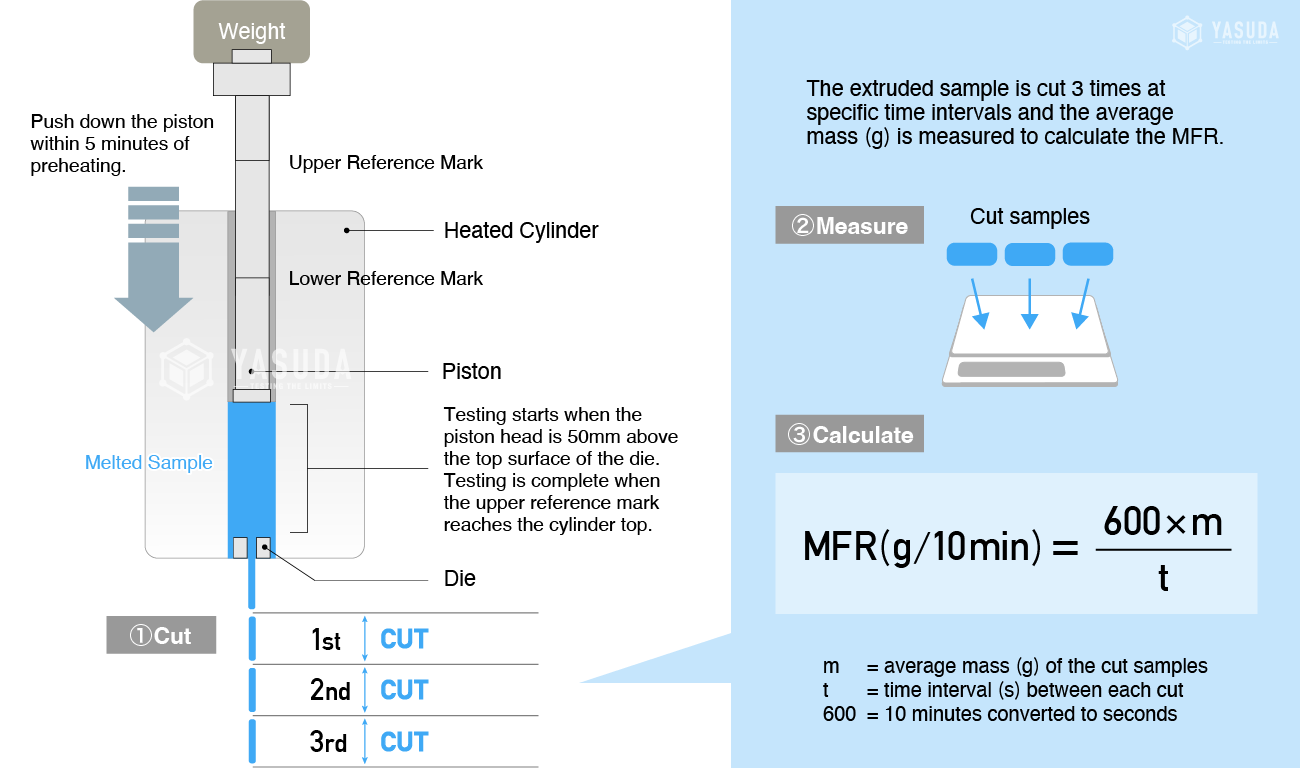
There are several methods used to determine the fluidity of resin, and melt flow test is the easiest method that gives a simple index.
Samples are tested with an extrusion plastometer under conditions and instructions specified in the test standard (e.g., ISO 1133, JIS K7210, ASTM D1238). There are several procedures included in the test standards. The most common are procedures A and B.
In procedure A, in a form of pellets or sometimes powder, the test sample is charged into a heated cylinder. After preheating for a specific period of time, a constant load is applied to the melted sample and extruded from a die at the base of the cylinder. At specific time intervals, the extrudate is cut. The masses of the cut samples are measured to calculate the mass extruded for 10 minutes. (See below for a step-by-step procedure.)
In procedure B, instead of cutting the extrudate at specific time intervals, either of the following is measured:
1) the distance the piston travels for a specified time,
2) the time duration of the piston traveling a specified distance.
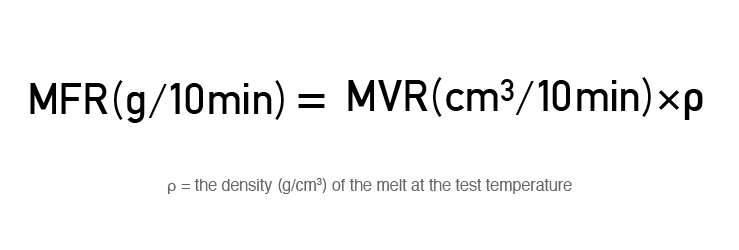
Test results are expressed in either MFR (g/10 min) or MVR (cm3/10 min). MFR describes the mass while MVR describes the volume. The MFR can be determined by multiplying the MVR and the density of the melted sample.
MFR corresponds to the molecular weight of resin. MFR is lower for resin with higher molecular weight. Whereas, MFR is higher for resin with lower molecular weight. In most cases, as the MFR value becomes higher, melted resin flows more easily and processing becomes easier. Tensile strength, however, weakens.
Test Procedure
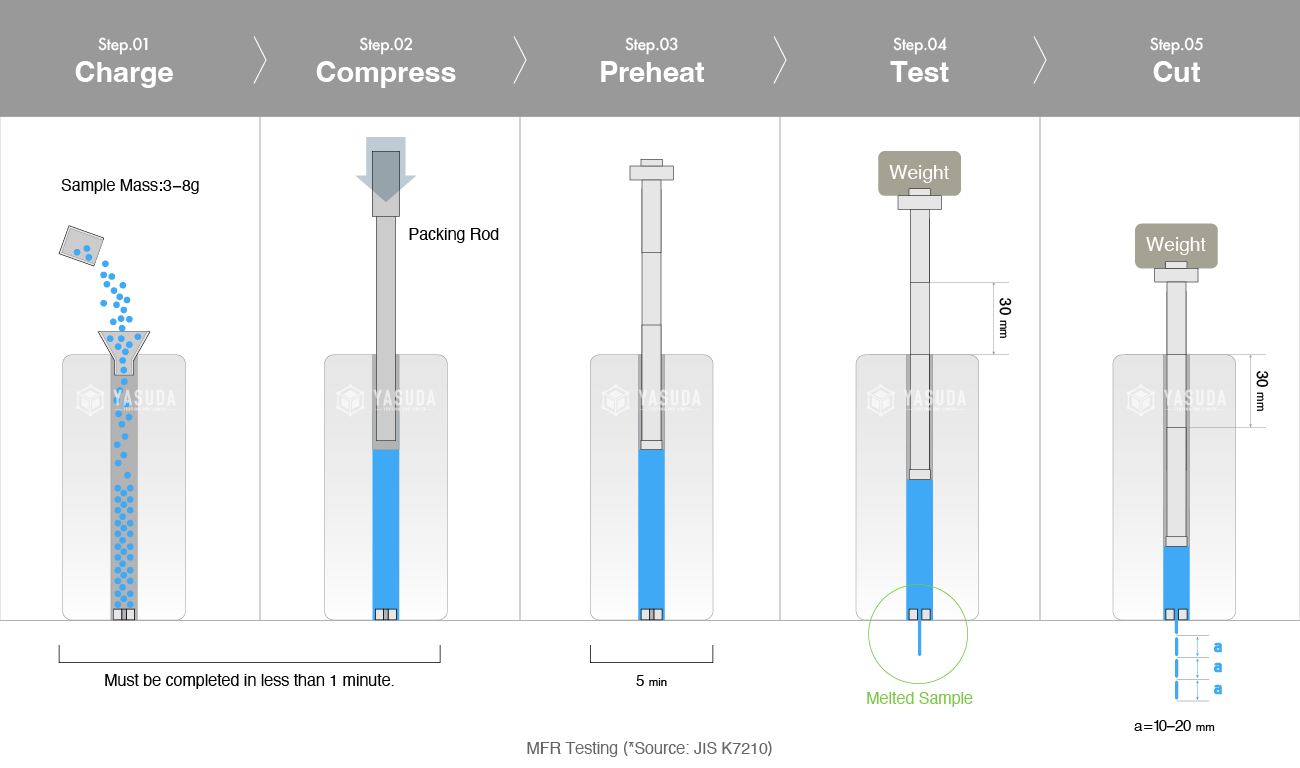
Procedure A
- Fill the heated cylinder with the sample.
- Compress the sample with a packing rod (to remove the gases trapped in the sample).
- Insert the piston into the cylinder and set the test weight.
- Preheat for 5 minutes.
- Start testing when the piston’s lower reference mark reaches the cylinder top (in other words, when the piston head is 50 mm above the top surface of the die).
- At specific time intervals, cut the extruded sample. Cut and take at least 3 strands of extrudate.
- Measure the mass of the strands and calculate the MFR (g/10 min) using the formula as shown in the next section.
MFR and MVR Calculation
Procedure A
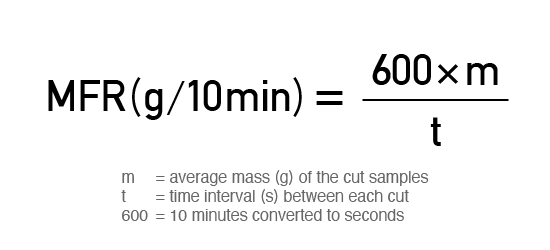
The sample is cut at specific time intervals (e.g., 60 seconds) and the mass of the cut resin is measured.
MFR is given by the following equation.
Procedure B
Time how long the piston takes to travel for a specified distance.
MVR is given by the following equation.
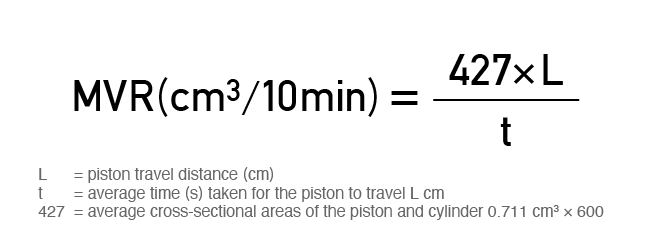
To calculate the MFR from MVR, measure the sample density and use the following equation.
Simple Test, Simple Index
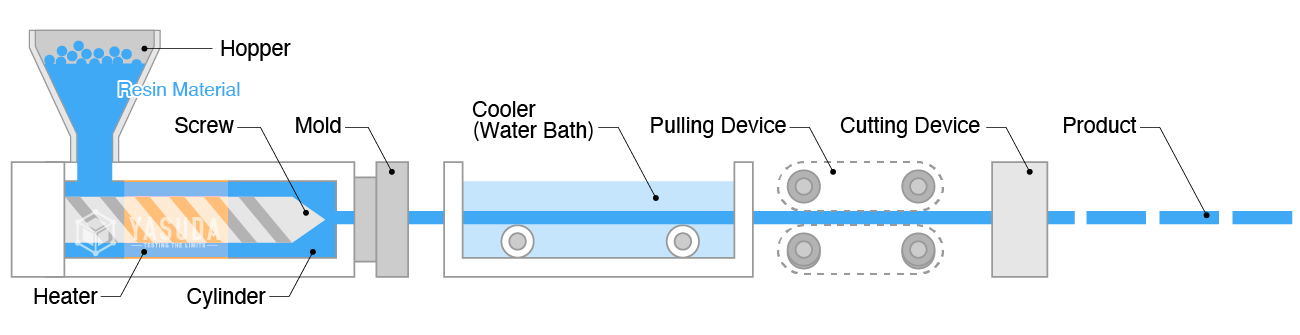
In extrusion molding, as shown in the illustration below, a sample is poured and melted in a heated cylinder, then extruded from a die. Sounds familiar? Melt flow test recreates and also simplifies the process of extrusion molding. Due to its simplicity, MFR is commonly used as a basic index in the quality control of plastic materials.
Do Melt Flow Tests Produce Different Results?
MFR and MVR can easily be affected by the moisture (water absorption) of the sample pellet, the resin or filler (such as glass fiber and carbon fiber) content of the sample. The results of melt flow tests can also vary among the different operators due to their difference in their techniques. Therefore, for more consistent results, testing is to be operated by the same person under the same conditions.
As one solution, Yasuda provides automated testers that perform the test for the operator.
Yasuda’s Melt Flow Index Testers
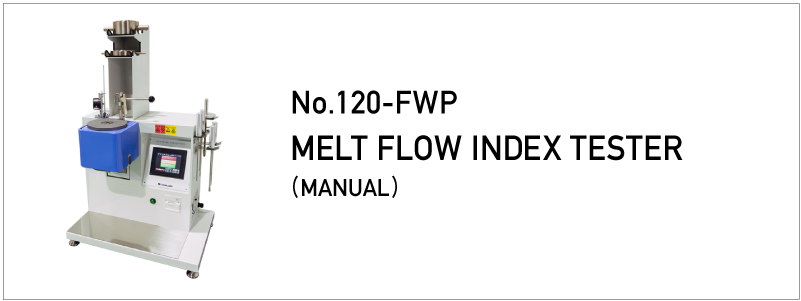
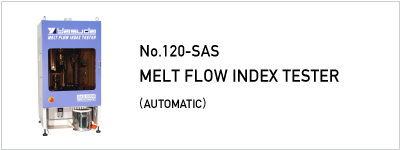
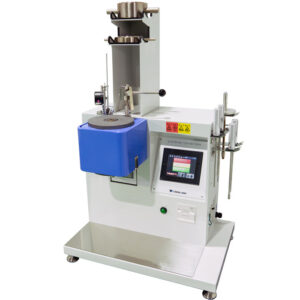
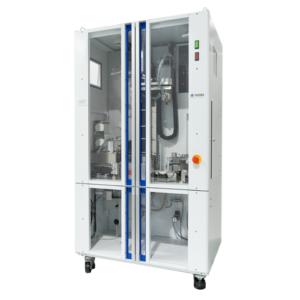
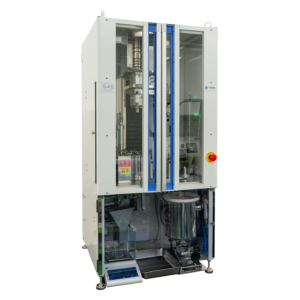
At Yasuda, we have three main models of Melt Flow Index Testers: FWP, SAS, and LABOT. Our No.120-FWP is a manually operated model. Whereas, SAS and LABOT are automatically operated by setting the test conditions in a PC. The latter models also clean the heated cylinder and die during their automatic operation and reduces the work of the operator. Hence, cutting the time for melt flow testing and increasing the efficiency of the operator’s work. By automating the test process, the results are also more stable than when testing is performed by different operators.

See how our Auto Melt Flow works
Related products
PRODUCT INFORMATION
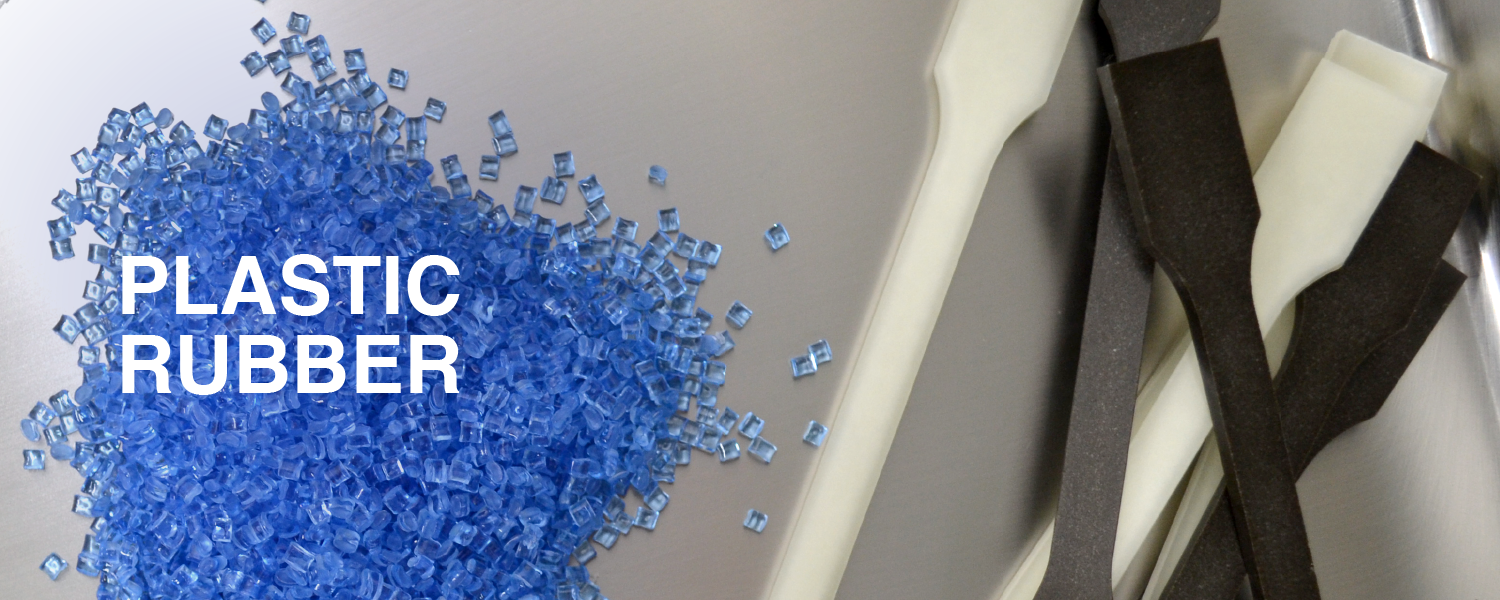 Plastic and RubberProducts used to test various elements of physical properties of plastic and rubber materials, such as flow rate, impact resistance, abrasion resistance and heat resistance, can be found in this page.
 Tape and FilmTape and film are used in many applications, and we have products that provide means to evaluate the materials according to the application, in aspects such as decrease in adhesion strength or heat resistance.
 Electrical Cable and Enameled WireThe safety of electrical cables and enamel wires is extremely important, and we provide the means to examine them. There are various products for testing electrical wires and cables, examining the stability and durability against voltages, heat resistance, abrasion resistance, and the flexibility.
 Leather and Vinyl Leather ClothFlexibility and everlastingness are required on all kinds of natural/synthetic leather products. We have products to inspect the properties of natural/synthetic leather, providing a means to determine whether the material meets the requirements to be processed as a product.
 Paper and Pulp, Cardboard and PackagingPaper and pulp are versatile and essential materials as they have various applications. We have products that can be used to measure their signature properties, such as absorbance, permeability, resistance to bend, wear and tear, and strength against compression.
 Textiles and NonwovensTextiles and nonwovens are among the materials we interact the most in everyday life in the form of clothing, fabric and filtration, and the importance for their reliability, feel, safety and durability is just as high. We have various products for testing textiles and nonwovens that test exactly these physical properties.
 Paint, Pigment and InkPaint, pigment, and ink are frequently used materials in manufacturing, applied to decorating products and/or enhancing their durability. To make sure they meet their requirements, we have products that measure their thickness, sag properties, and physical durability.
 Automotive PartsMany materials such as rubber, plastic, and electric wires are used in automotive components, and physical property testers are used for testing most of these materials. Yasuda Seiki Seisakusho, Ltd. has numerous successful installations of these testers, particularly in Japan where automobile production is prominent. Some examples of physical property testers used in the automotive industry are introduced on this page.
 Past Custom-made ProductsWe believe that there are as many testing methods and test applications as there are final products, and we have provided custom testing equipment that suits a particular material. This page describes a few of the custom-made products that YASUDA SEIKI produced and provided in the past to meet specific needs from customers.